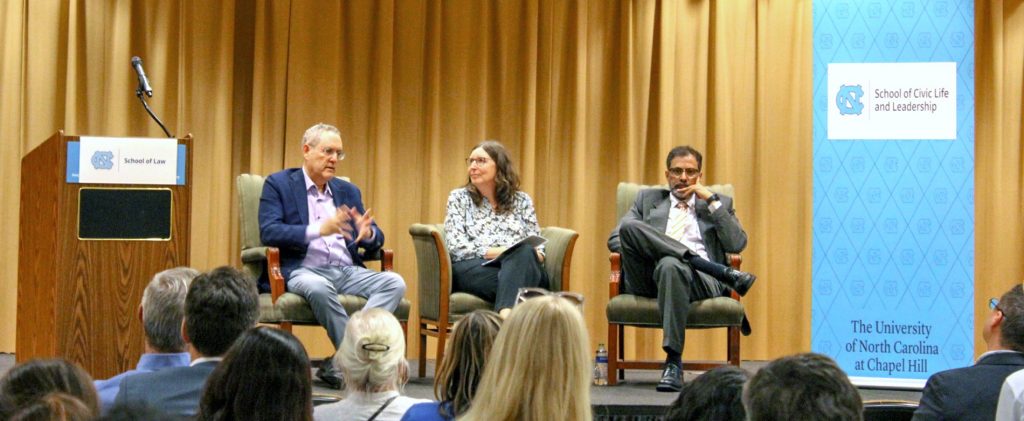
The presidency was built to fix a specific failure: a national government with no executive at all. By 1787, that experiment had already collapsed, and the office the framers built to replace it has kept growing since, well past what its own designers intended. Two constitutional scholars traced that growth at a Constitution Day panel on September 14, co-hosted by UNC School of Law and the Program for Public Discourse, housed in the UNC School of Civic Life and Leadership, at the Sonja Haynes Stone Center.
Dean Andy Hessick opened the evening. The Constitution’s original text runs under 4,000 words; with two centuries of amendments, it’s still under 8,000. Nearly every one of those words, Hessick told the crowd, has been the subject of debate, because the document does so much with so little. Ambiguity was inevitable, and the framers knew it. James Madison had a term for how that ambiguity gets worked out over time, through practice and disagreement: liquidation. The fact that Americans are still arguing over what the Constitution means, Hessick said, isn’t a failure, but proof the document still matters.
Jed Atkins, dean of the School of Civic Life and Leadership, welcomed the room and tied the evening to the coming 250th anniversary of the Declaration of Independence, framing the panel’s topic as a question the founders wrestled with from the start: how do you build an effective executive without a king?
Moderator Suzanne Globetti, a teaching associate professor in the University’s political science department, opened the discussion with a single sentence from Article II: “the executive power shall be vested in the president.” She put the question to Michael Gerhardt, the Burton Craig Distinguished Professor of Jurisprudence at Carolina Law, and Sai Prakash, the James Monroe Distinguished Professor of Law at the University of Virginia.
Prakash laid out two ways to read that clause. Read narrowly, it just points to the powers listed elsewhere in Article II, like appointments and treaties. Read broadly, it hands the president a much wider set of powers on its own, including the authority to remove officials and take the lead on foreign affairs.
Gerhardt went back further. The Declaration of Independence’s list of grievances against King George III, he said, was written like a set of impeachment articles, 27 of them, by a generation determined to hold a ruler accountable. That instinct ran so deep that the Articles of Confederation left law enforcement to Congress alone and created no executive branch at all. Congress made a poor executive, Prakash added, so delegates in Philadelphia built a presidency stronger than any state governor’s office: a veto most states didn’t give their own executives, an unconditional pardon and the vesting clause the panel had just spent several minutes debating. Critics at the time, Prakash said, called it an elective monarchy in disguise. Even John Adams praised the office’s monarchical elements.
That strong presidency has only grown stronger since, both scholars said. Prakash pointed to a shift in what voters expect. Candidates didn’t campaign on policy promises at all until the late 19th century, on the theory that only Congress could make such promises good. Today, presidents run on agendas the Constitution gives them no direct power to deliver, and when Congress won’t cooperate, they look for ways around it, helped by a weakened party system that leaves much of Congress reluctant to check a president from its own side.
Gerhardt reached for a term coined by historian Arthur Schlesinger Jr., the “imperial presidency,” to describe the same drift: Congress delegates power it doesn’t want to use, or fails to act, and the presidency fills the vacuum and rarely gives it back. He traced the pattern through Woodrow Wilson, who began his academic career convinced Congress was the engine of government and wrote a book called “Congressional Government” to that effect. By the time Wilson became president himself, Gerhardt said, he saw it differently, using Congress when he needed it, for a declaration of war, and ignoring it when he didn’t, authorizing the Palmer Raids against American citizens without congressional sign-off.
Modern presidents have their own toolkit. Signing statements let a president announce which parts of a new law he actually plans to enforce. Withholding funds Congress has already appropriated lets him redirect a budget after the fact. War powers have followed the same pattern: neither Korea nor Libya involved a formal declaration of war, and both left modern presidents assuming they can send troops into combat without asking Congress first.
The conversation turned to the courts, and to the unitary executive theory, the idea that the president must control the exercise of executive power wherever it occurs in the federal government. Gerhardt traced the theory to a Supreme Court dissent by Justice Antonin Scalia, whom he knew personally; he helped arrange Scalia’s final public speech and asked him about the theory directly that night. The courts have moved toward it incrementally since, Gerhardt said, though how far remains unsettled.
Prakash defended the theory’s core claim, that the president alone controls how laws get executed, comparing it to the judicial power belonging to judges rather than their law clerks. But that claim isn’t license for a president to make war or spend money Congress never appropriated, he said, pointing back to the tools Gerhardt had just described.
During the audience Q&A, a student asked how any of this squares with the president being democratically elected. Gerhardt answered that the Constitution was built to guard against pure majority rule; only the House was directly elected under the original text. He pointed to Theodore Roosevelt’s “stewardship” theory of the presidency, the idea that a president could do anything the public would support, as evidence that the impulse predates any modern legal theory. He also described a recent moment from Senate testimony: the Secretary of Homeland Security, asked whether his department would comply with an adverse district court ruling, answered that it depends on whether the administration agrees with it.
Prakash traced that same impulse to Andrew Jackson, whose claim of a governing mandate from the voters was dismissed by his own contemporaries in Congress as absurd. What actually moves a modern president, he argued, has less to do with persuasion than with control over a loyal party, a point he illustrated with John Tyler, one of the least popular presidents in American history, who nonetheless annexed Texas unilaterally near the end of his term, with Congress falling in line afterward.
Asked what might restore the balance and limits on presidential power, Prakash and Gerhardt landed in roughly the same place: Congress reasserting itself, the public expecting less from any one president, and the people running each branch actually using the checks the Constitution gives them.