
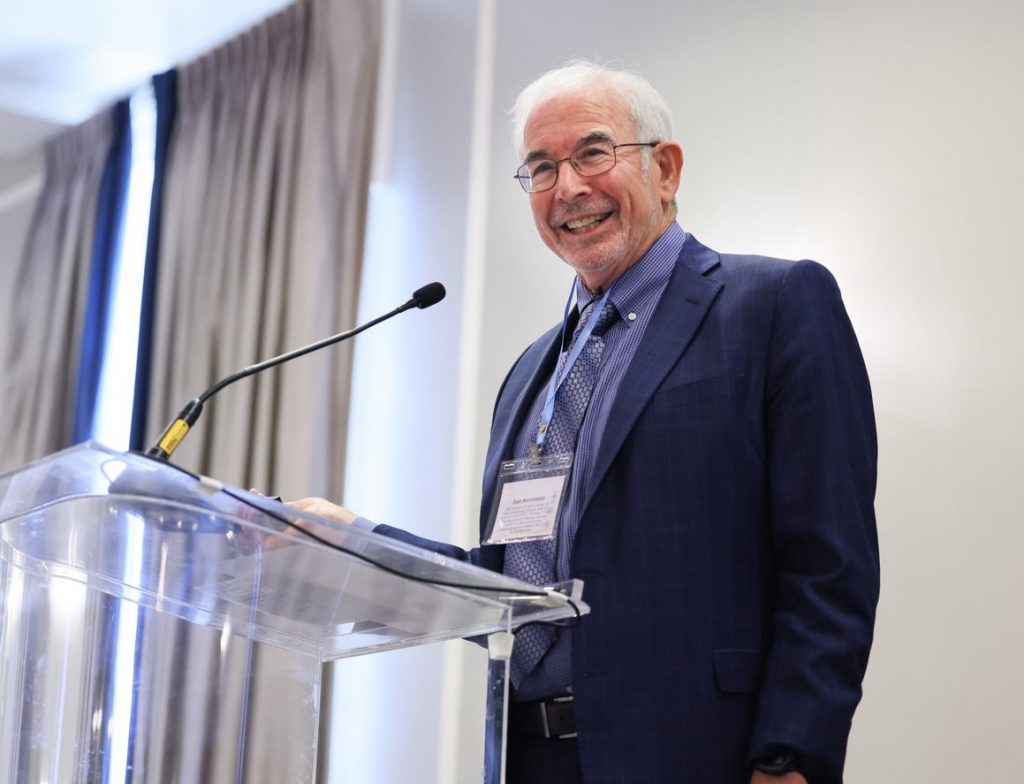
Thomas F. Taft Distinguished Professor and director of the Center for Risk, Resilience, Energy, and the Environment
In London, on June 10, North Carolina’s coastal insurer of last resort made history. For Don Hornstein, the Thomas F. Taft Distinguished Professor of Law and director of the Center for Climate, Energy, Environment, and Economics, it was the culmination of a 15-year vision. On June 10, the world’s first resilience catastrophe bond, a $600 million innovation that Hornstein helped design, won Initiative of the Year at a black-tie gala attended by more than 300 of the world’s top international insurance specialists.
In many ways, this was no surprise. More than a year earlier, in May 2025, Carolina Law’s student-run Environmental Law Project won Pro Bono Project of the Year for the work of more than a dozen law students who confirmed that this resilience catastrophe bond would indeed be the world’s first such financial product.
The Journey Begins
The road to international recognition began in 2008, when Hornstein was appointed by the North Carolina General Assembly to solve a problem that has become all too familiar: insurers leaving coastal areas because they weren’t allowed to charge enough in rate to withstand losses caused by increasingly volatile weather. Hornstein accepted the appointment with a clear insight: the only way to break the cycle of rate increases and insurer insolvencies was for insurers to promote and reward climate-resilient construction. Study after study had shown that resilient construction more than paid back the investment, often many times over.
In the 2008 legislative study commission, Hornstein, aided by the work of his research assistant Daniel Peterson ’10, pitched an idea that would soon take root: authorizing North Carolina’s newly designed coastal insurer of last resort, the North Carolina Insurance Underwriting Association, to create its own affirmative mitigation program. In 2009, the General Assembly enacted House Bill 1305 with statutory language that authorized the new entity to do exactly that.
Almost immediately, Hornstein was appointed by Wayne Goodwin, the state’s commissioner of insurance, to the North Carolina Insurance Underwriting Association’s board of directors. Within a few years, Hornstein and Gina Hardy, the association’s CEO, began laying the groundwork for storm-ready construction at the North Carolina coast, partnering with the Institute for Business and Home Safety, the insurance industry’s research facility dedicated to improving home resiliency. Institute for Business and Home Safety had designed better-than-code roof upgrades known as Fortified roofs. In test after test at Institute for Business and Home Safety’s wind tunnel outside Charlotte, the largest such facility in the Western Hemisphere, Fortified roofs regularly outperformed even brand-new code roofs.
In November 2016, the North Carolina Insurance Underwriting Association’s board authorized the launch of its first resilient-building program, providing a free “endorsement” to policyholders on the Outer Banks and Barrier Islands: whenever they were entitled to a roof replacement, the North Carolina Insurance Underwriting Association would install an upgraded Fortified roof at no additional charge. Almost immediately, Hornstein was asked by the Obama White House to fly to Washington, D.C., to explain the initiative, which the White House Office of Management and Budget soon recognized as breaking new ground on insurer-led climate resilience. One week later, the World Bank asked Hornstein to brief its policymakers on the development. He recounted all of it in a TEDx talk at the North Carolina School of Science and Mathematics. In the years since, the North Carolina Insurance Underwriting Association has expanded on that first program, investing $130 million to install more than 20,000 Fortified roofs on the North Carolina coast, the largest such investment in resilience by a single insurance company in the world.
The Moonshot: Creating a New Financial Instrument
Like many insurers, the North Carolina Insurance Underwriting Association purchases reinsurance (insurance for insurance companies), as well as an analogous financial product known as an insurance-linked security catastrophe bond as a source of ready capital in the event of significant storm-related losses. In 2015, Hornstein read a Brookings Institution report by Dr. Shalini Vajjhala speculating that insurance-linked security catastrophe bonds could be designed to help finance climate resilience investments. But for the next decade, no one in the insurance world had found a way to make an insurance-linked security catastrophe bond a reality. As the North Carolina Insurance Underwriting Association’s investments in storm-resilient housing grew, Hornstein became convinced they could provide the bedrock for exactly such a financial product.
In summer 2024, Hornstein took the first steps to make it happen. He began with an invited lecture on July 4, 2024, in London at the offices of Marsh McLennan, the world’s largest insurance consultancy, where he first linked the North Carolina Insurance Underwriting Association’s resiliency investments to the type of insurance-linked security catastrophe bonds Dr. Vajjhala had envisioned. In August, he contacted Cory Anger, a senior manager at Guy Carpenter Securities in New York City, to enlist her help. Anger, in turn, brought in Tom Beckmerhagen, the principal lead underwriter at Hannover Re, one of the largest reinsurers in Germany. Together, Anger and Beckmerhagen flew to Raleigh in September 2024 to meet with Hornstein, Gina Hardy and other North Carolina Insurance Underwriting Association executives for lunch at Seasons 52 in Crabtree Valley Mall. There, over lunch, the group sketched out the key financial terms of the world’s first insurance-linked security catastrophe bond for the first time.
Within six months, Hornstein, Hardy and the North Carolina Insurance Underwriting Association’s financial team flew to New York City, London and Zurich, pitched the Association’s new resilience catastrophe bond, and secured $600 million in investments. By spring 2025, the North Carolina Insurance Underwriting Association had launched the world’s first resilience catastrophe bond. Artemis, the Bermuda-based news outlet covering the reinsurance and catastrophe bond world, captured the significance of the launch.
Carolina Law’s Newest Center, and Where Things Go From Here
In 2025, Hornstein was asked to take over the Center on Climate, Energy, Environment, and Economics. One of his first requests was to seek University permission to rebrand the center so that, in addition to energy law and environmental law, it would also specialize in the kind of insurance-linked climate resiliency work he and Environmental Law Project students had been pursuing. The University granted that permission in fall 2025, the same time Hornstein secured funding to hold Carolina Law’s first conference on insurance-linked investments in climate resiliency.
That conference took place Oct. 23-24, 2025, drawing more than 150 attendees to the Carolina Club to hear from a who’s-who of experts: Dr. Vajjhala, whose Brookings paper inspired it all; representatives of the world’s largest reinsurers; financing specialists from the World Bank, the Nature Conservancy, and Marsh McLennan; Gina Hardy and North Carolina Insurance Commissioner Mike Causey; and Cory Anger, Tom Beckmerhagen and Hornstein.
Since then, there’s even more to report. Carolina Law secured funding for a second, even larger conference, held at the Carolina Inn on Friday, Oct. 9, where Hornstein, Dean Hessick and Carolina formally announced the Center on Climate, Energy, Environment, and Economics’s transformation into the new Center on Risk, Resilience, Energy, and the Environment. This year’s conference reported further on North Carolina Insurance Underwriting Association-led breakthroughs in the insurance-resiliency connection and added a two-hour afternoon session on energy law. The Clean Energy Fund Carolinas reported on its recent $4 million investment from the North Carolina Insurance Underwriting Association to install Institute for Business and Home Safety super-roofs for low-income policyholders who can then qualify for additional energy-efficiency funding. The session also covered the energy and insurance demands of AI data centers, a hot topic ahead of the fall elections, along with innovations in distributed energy resources in North Carolina and beyond.