Tom Beckmerhagen made the trip from Germany. Swenja Surminski flew in from London. Vincent Boland came from St. Lucia, navigating through the Caribbean just as Hurricane Melissa passed by. By Friday morning on October 23rd, they’d all gathered at the Carolina Club alongside insurance executives from New York and students who’d spent months researching catastrophe bonds. One question brought them together: how do you pay for resilience before the next storm hits?
In late 2024, Tropical Storm Helene tore through Western North Carolina, causing $60 billion in damages and making it the largest natural disaster in state history. Just weeks before the conference, 12 homes fell into the ocean in Buxton. Insurance Commissioner Mike Causey opened the gathering by making the moment clear. “We have the best beach plan and FAIR plan in the United States,” said Causey. “What you’ll be talking about this morning is the world’s first climate resilience bond. That is a huge deal.”
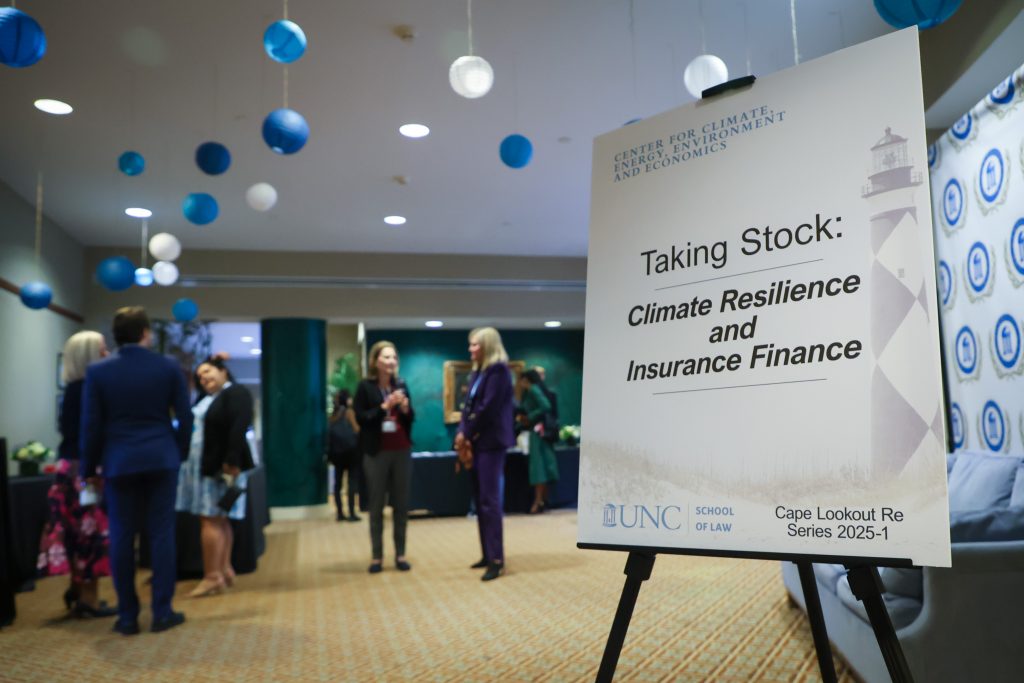
UNC School of Law’s day-long conference, Taking Stock: Climate Resilience and Insurance Finance, brought together one of the largest gatherings on climate resilience and insurance finance ever held at a U.S. university. At its center sat a $600 million bond that does something the insurance world had never seen — pay investors to fund storm-resistant construction before disasters strike, not just after.
The story of this bond starts in 2008. North Carolina faced an insurance crisis and major insurers fled the state. Carolina Law professor Don Hornstein, newly appointed to the N.C. Insurance Underwriting Association board, had what seemed like a simple idea: insurers shouldn’t just help people recover after disasters. They should invest in preventing damage before storms hit.
Seventeen years of patient work followed. The NCIUA invested over $130 million in resilient construction. This investment funded more than 20,000 FORTIFIED roofs across North Carolina’s coast, making it the largest single-insurer resilience initiative in the world. FORTIFIED roofs aren’t ordinary roofs; they’re engineered to withstand severe storms, and the data proves that they work. These reinforced roofs cut hurricane damage claims by 35% and weather-related claims by nearly two-thirds.
But the real breakthrough came when Hornstein, who directs Carolina Law’s Center on Climate, Energy, Environment, and Economics (CE3), started asking a bigger question: could you turn that resilience work into a financial product that would generate even more funding? In 2015, Hornstein read an academic paper by Shalini Vajjhala, then at the Brookings Institution, proposing exactly that concept. The idea sat there, waiting for someone to build it.
Hornstein began meeting with Cory Anger from Guy Carpenter Securities, Tom Beckmerhagen from Hannover Re and NCIUA CEO Gina Hardy. The team spent months designing the bond’s structure, figuring out how to price resilience, how to attract investors and how to make it work. In early 2025, they took the bond on a road show to investors in London, Zurich, and New York.
The response exceeded everyone’s expectations. The bond raised $600 million, which was nearly double its original $350 million target. Artemis, the leading publication covering global insurance markets, called it the world’s first insurance-linked security to combine traditional catastrophe protection with a resilience incentive.
The conference brought the team back together, this time joined by international leaders eager to understand how North Carolina did it. Beckmerhagen, who traveled from Germany to walk through the bond’s technical details, told attendees the model is ready to replicate. “North Carolina can show every other state how to do this,” said Beckmerhagen. “Everything was done here: the political will, the transactional features. It’s basically copy and paste for other markets.”
The timing matters. The federal government prepares to announce results of the FEMA Review Council in November, with major cuts to federal disaster assistance expected. President Trump has signaled his intention to shift more responsibility to states, local governments, and the private sector. North Carolina’s model suddenly looks less like an experiment and more like a blueprint for what comes next.
“This is Carolina at its best, applying rigorous research to solve real-world problems that affect millions of people,” Interim Dean Andy Hessick told the packed room.
Swenja Surminski, managing director of Climate and Sustainability at Marsh McLennan, spent the prior Thursday with Carolina Law students before addressing the full conference. “What’s happening here in North Carolina is inspirational,” said Surminski. “While every country is grappling with similar challenges, the solutions developed here are showing the rest of the world what’s possible.”
The conversation ranged across continents and innovations. Eric Roberts from The Nature Conservancy presented work on insuring coral reefs in Hawaii for their wave-dampening properties. Vincent Boland from the World Bank shared approaches under development in vulnerable Caribbean nations. Karl Bernier from Swiss Re and James Doona from Munich Re explained parametric insurance, which triggers immediate payouts based on storm intensity rather than waiting months for damage assessments.
Abby Ross, CEO of The Resiliency Company, announced plans to adapt North Carolina’s approach for Los Angeles wildfire recovery, launching a $200 million resilient lending fund. “This can be a new model for financing homes to an insurable resilience standard across the entire country,” said Ross.
The work has opened doors for Carolina Law students. They worked alongside Hornstein on the bond’s development, conducting research on legal structures and policy frameworks. Their efforts won the school’s Pro Bono Project of the Year award in May 2025. During the conference, as these students watched global experts discuss the bond they’d helped create, Hornstein invited them to stand and told them, “You’re going to be coming to conferences 10 years from now.”
Kratika Tandon, a second-year law student and co-president of the Environmental Law Program, saw the conference as a window into her future career. “This was an incredible opportunity for students to immerse themselves in the world of reinsurance and understand its role in advancing climate resilience,” said Tandon. “We are deeply grateful to have had the chance to hear from some of the leading voices in this field and gain insight into the impactful, cutting-edge projects that they are driving worldwide.”
Hornstein closed by connecting the conference to Carolina’s broader mission. “This embodies Carolina’s mission of applying research to real-world challenges,” said Hornstein. “And it shows how North Carolina’s public universities are helping shape global innovations in climate and insurance resilience.”
As the afternoon wound down and attendees filed out of the Carolina Club, the real work was just beginning. The international travelers headed home. The students returned to class. But the blueprint they gathered to study, refined over 17 years from crisis to breakthrough, now stands ready for the next state, the next country, and the next storm.