By: Michele Lynn
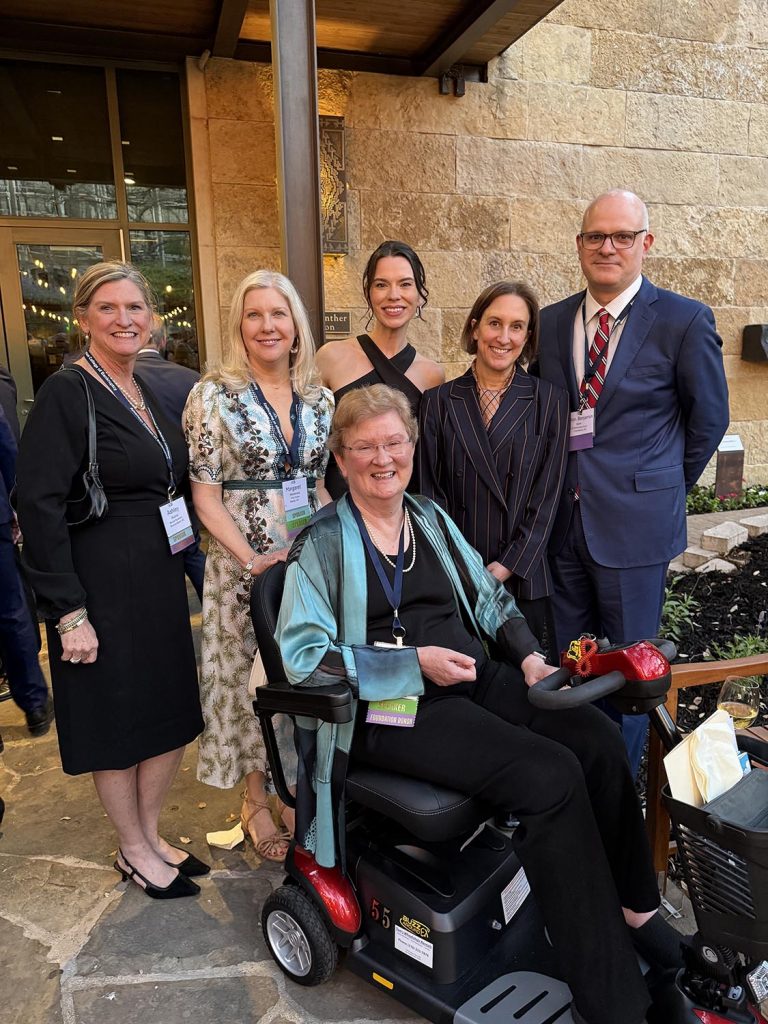
Talk to peers and colleagues about S. Elizabeth Gibson ’76, Burton Craige distinguished professor of law, emerita, and you hear nothing but superlatives: she is the smartest person in the room…a beloved teacher and engaged scholar…warm and inviting…modest…a living legend.
For her enduring contributions to bankruptcy law and procedure, the judiciary, and the legal profession, Gibson was honored by The American College of Bankruptcy with the Distinguished Service Award in March.
In her remarks upon presenting the award to Gibson, Melissa B. Jacoby, Graham Kenan Distinguished Professor of Law, Emerita, said,
“Elizabeth Gibson has consistently reinvested her success and smarts into the betterment of this field, and into her mentees from the classroom and beyond. She has modeled hard and careful work, operating under the highest ethical standards. She has inspired so many other people to, as they say, ‘give back’ and “pay it forward.’”
Gibson’s storied career includes clerking on the U.S. Supreme Court, being on the fast track to partnership at an elite Washington, D.C. law firm and holding an endowed professorship at UNC-Chapel Hill that is reserved for only the “exceptionally distinguished.” She was nominated by President Clinton to serve as a judge on the U.S. Court of Appeals for the Fourth Circuit, but her nomination expired without the U.S. Senate taking action.
While she did not serve on the bench, Gibson has had a big impact on it. Six of her former law students from her 33 years on the faculty have been selected to serve as federal bankruptcy judges. Those alumni collaborated on a letter included in the nomination packet for the award she received last spring, which noted that a significant portion of the current bankruptcy practitioners in the Southeast trace their bankruptcy education and decision to practice bankruptcy law to Gibson.
In that letter, the jurists wrote about Gibson, “She taught with clarity, compassion and humor. She was beloved by the students, a fact recognized by receiving the Thomas Jefferson Award in 2016, an award presented by the chancellor and representing a recognition by the entire UNC-Chapel Hill faculty for her excellence in teaching, scholarship and service; the McCall Award for Teaching Excellence (voted on by the graduating class) three times; the University Mentor Award for Lifetime Achievement in 2010, and the Robert G. Byrd Award for Excellence and Creativity in Teaching in 2012.
Her legacy looms large. The Law Alumni Association’s Professor S. Elizabeth Gibson Award for Faculty Excellence, of which she was the inaugural recipient, annually honors a tenured faculty member of UNC School of Law who typifies the outstanding qualities of integrity, legal scholarship, exemplary teaching and commitment to service to Carolina Law and the University. She received a Distinguished Alumni Award from Carolina Law in 2024.
One of Gibson’s former students, Margaret Westbrook ’96, is grateful to have her as a mentor. Westbrook is a partner at law firm K&L Gates where her main practice area and focus is restructuring and insolvency, which she first learned about in Gibson’s classes. “It’s remarkable that she had very special experiences with so many of her students — either in class or outside of it — and helped shape their careers, pushed them forward or wrote them a letter of recommendation, while building a true bond and closeness,” said Westbrook.
Martin Brinkley ’92, William Rand Kenan Jr. distinguished professor of law and dean emeritus, is another former student who sings Gibson’s praises. “It would be hard to name any faculty member who was more important than Elizabeth Gibson at the School in her time,” said Brinkley. “She showed that it was possible to be a really great lawyer and law professor and be a person who at the same time is kind and decent and not difficult or argumentative.”
Gibson said that the best part of teaching was getting to know students and having an impact on them. While she only had a little experience with bankruptcy issues in her practice in Washington, D.C., Gibson agreed to teach the subject when she began teaching at Carolina Law in 1983. It turned out to be a great fit with her interest in procedural issues in federal courts. “It covers a range of legal subject matter, because a person or company filing for bankruptcy has many issues that might involve family law, tax issues or tort issues,” said Gibson.
Gibson’s teaching and research in the areas of bankruptcy, civil procedure and federal jurisdiction have been far reaching and formative to the field. Her vast service includes years as a member of the board of editors for Collier on Bankruptcy, the National Bankruptcy Conference and the American College of Bankruptcy. Her tenure as a reporter for the advisory committee on bankruptcy rules has been instrumental in shaping the bankruptcy system in the country.
“Her work on the rules committee cannot be overstated,” said Westbrook. “Everyone credits her with such a tough job in making the Bankruptcy Code and the practice and the function of the courts better for everyone — lawyers, clients and judges.”
In October, the Carolina Law is hosting the Discovering Restructuring Expertise and Mentorship Symposium, organized by the American College of Bankruptcy. With mentoring a central focus of the symposium, it connects leading professionals and is meant to inspire a wide range of students to think broadly about their career options, including judicial clerkships and perhaps even judgeships of their own.
Kara Bruce, Graham Kenan distinguished professor of law, said that having the symposium at Carolina Law demonstrates how central the School is in the insolvency and finance communities. “This is an area of law in which there is more demand for skilled and well-informed attorneys than there is supply,” said Bruce. “The symposium reflects the type of work that Elizabeth Gibson did to get students interested in and prepared to do these jobs, and then also connect them with opportunities.”
The symposium, which is open to students from all law schools, offers these future attorneys the opportunity to meet judges and lawyers in the field and learn more about the bankruptcy and insolvency field. “Bankruptcy courts are the busiest courts on the federal level in America,” said Melissa B. Jacoby, Graham Kenan distinguished professor of law, emerita. “Triangle Discovering Restructuring Expertise and Mentorship Symposium is a great opportunity for students to get a glimpse of this fascinating corner of the legal world and to meet some wonderful people who have built inspiring careers there.”
To learn even more about Elizabeth Gibson, read the transcript of her oral history, recorded in 2016, which is part of the National Bankruptcy Archives at the University of Pennsylvania.