UNC School of Law professors spent two July lunches picking apart six new U.S. Supreme Court opinions and arrived at a common verdict: on case after case, the justices found the narrowest possible path through and left the hard questions for later.
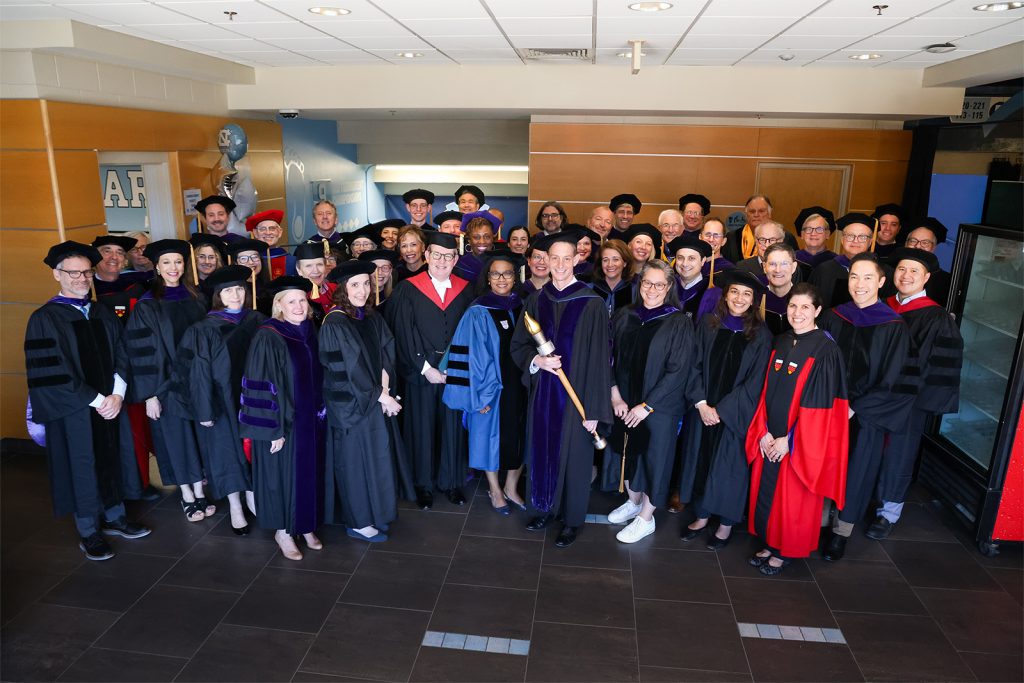
The occasion was the School’s summer Supreme Court lunch series, now in its latest year with a rotating cast of faculty presenters and, for the first time this year, trivia. As with any academic forum, the views below are each professor’s own scholarly analysis, not an institutional position. The series is organized by Kathleen DeLaney Thomas, associate dean for faculty development and Aubrey L. Brooks Distinguished Professor of Law, who calls it one of the highlights of the summer. “It gives us the chance to come together as a community and hear directly from our own nationally recognized scholars about the Court’s most significant decisions,” said Thomas. “Not just what the Court decided, but why those decisions matter.”
Kara Bruce, the Graham Kenan Distinguished Professor of Law, and Carrie Floyd, an assistant professor and director of the School’s Civil Clinic, opened with Keathley v. Buddy Ayers Construction. A Chapter 13 debtor who never formally disclosed a personal injury claim in his bankruptcy filing lost that claim to judicial estoppel under a Fifth Circuit rule so rigid that almost no omission could count as inadvertent. Justice Jackson’s unanimous opinion rejected that rule in favor of a totality-of-the-circumstances test that five other circuits already used but left open whether judicial estoppel applies to bankruptcy petitions at all. Bruce and Floyd’s sharpest point: in these disputes, the debtor rarely benefits from concealment. Creditors are the ones harmed, and the tortfeasor is the one who profits from a rigid estoppel rule. From the clinic, where Floyd supervises students on rent-to-own and predatory lending cases, the takeaway was blunt: always check what a client disclosed in bankruptcy before litigating anything connected to those assets.
Joe Kennedy, the Willie Person Mangum Distinguished Professor, took Case v. Montana next, a 9-0 decision upholding a warrantless police entry into the home of a man who had threatened suicide. Kennedy argued the unanimity hides two problems. The Court reaffirmed its “objectively reasonable basis” standard for emergency entries without saying where it falls between reasonable suspicion and probable cause. And it called the entry reasonable despite officers waiting 40 minutes outside, arming themselves with shields and rifles and never calling in a mental health professional or family member. Justice Sotomayor’s concurrence came close to a dissent on that point. Eisha Jain, the Henry P. Brandis Distinguished Professor of Law, joined to close with Chatrie v. United States, the Court’s first major decision on cell phone tracking since Carpenter. In a 6-3 decision authored by Justice Kagan, the Court held that accessing “location history” on cell phones is a Fourth Amendment search. The Court rejected the government’s argument that users assume the risk by opting into location services and permitting Google to access this information. The Court issued an important ruling in determining that this constitutes a “search” for purposes of the Fourth Amendment because individuals have a reasonable expectation of privacy in their cell phone location data. The Court remanded the question of whether the multi-step geofence warrant obtained by the government made the search “reasonable,” which raises the likelihood that ultimately, this ruling will not result in the exclusion of the evidence. The dissent argued that the “good faith” doctrine would almost certainly apply, and therefore called the majority’s opinion advisory. Jain argued that there are good reasons to settle the search question, regardless of the suppression issue, and noted that the Court clarified Carpenter’s reach in significant ways.
Across all three cases at the first lunch, faculty kept landing on the same complaint: strong, unanimous-sounding votes that resolved almost nothing underneath. As Kennedy put it, if the measure of good lawmaking is whether it reduces or increases future litigation, this stretch of decisions gets a low grade.
A second lunch on July 30 turned to executive power, immigration and separation of powers. Daniel Rice, an assistant professor of constitutional law, opened with Trump v. Slaughter, the culmination of a century-long fight over the unitary executive theory: the idea that the president alone holds all executive power and can remove anyone who exercises it. After fifteen years of the Court marching back toward that view through Free Enterprise Fund v. Public Company Accounting Oversight Board and Seila Law LLC v. Consumer Financial Protection Bureau, it finished the job this summer, overruling Humphrey’s Executor and upholding Trump’s removal of Federal Trade Commission Commissioner Rebecca Slaughter. Rice noted that the opinion seems deliberately ambiguous in numerous respects. It repeatedly calls removable officials the president’s “subordinates” without saying whether that term reaches inferior officers, administrative law judges or ordinary civil servants. The same day, the Court carved out a separate exception letting the Federal Reserve keep its removal protections on historical-pedigree grounds. Rice found this move difficult to square with the majority’s own formalism and viewed it instead as a pragmatic carve-out to keep the ruling from destabilizing markets. He closed on the irony that a Court willing to overrule a precedent as entrenched as Humphrey’s Executor leaves Justice Kagan’s long defense of stare decisis with little left to stand on if the Court’s balance ever flips.
Rick Su, a professor of law focused on immigration, followed with Mullin v. Al Otro Lado, a 6-3 decision that drew little national attention but, he argued, will reshape asylum access more than any other case decided this term. Asylum is the only immigration category carrying an affirmative government obligation not to return someone to persecution, and Su traced two decades of policy changes narrowing that pathway, through maritime interdiction, the Remain in Mexico program and Title 42. The statute lets anyone who “arrives in” the United States apply for asylum, a phrase courts had read since 1986 to include presenting oneself at the border. Justice Alito’s majority broke with that reading, arguing “arriving in” requires physical entry and reaching for a football analogy: a runner stopped short of the goal line has not arrived in the end zone. Su was skeptical of the textual gymnastics, noting the statute’s roots in the aftermath of the St. Louis, the ship of Jewish refugees the United States turned away in 1939. His closing numbers did the real work: of an estimated 120 million forcibly displaced people worldwide, only about 9 million have filed asylum applications anywhere, and roughly 4 million of those claims are pending in the United States. He pointed out that the same “arriving in” language also governs the government’s general inspection obligations, meaning Mullin’s reasoning could extend well past asylum.
Eric Muller, the Dan K. Moore Distinguished Professor of Law in Jurisprudence and Ethics, closed with Trump v. Barbara, the birthright citizenship case, and began the discussion by correcting its own vote count. Reported as 6-3, Muller called it closer to 5-4 on the question that actually matters for most affected families. Executive Order 14160 denied citizenship, prospectively, to children born in the U.S. to temporary visitors and undocumented immigrants, turning the case on what the Fourteenth Amendment’s “subject to the jurisdiction thereof” adds to “born.” Chief Justice Roberts’s majority traced that phrase to English feudal, soil-based subjecthood, with narrow exceptions for ambassadors’ children, hostile occupation and tribal sovereignty; on that reading, United States v. Wong Kim Ark confirmed birth on U.S. soil controls regardless of a parent’s status. Justice Thomas, joined by Gorsuch, argued instead that citizenship turns on domicile and allegiance, meaning Wong Kim Ark says nothing about children of undocumented parents. Justice Kavanaugh sided with the majority on statutory grounds but volunteered that he would have upheld the executive order under the Constitution directly, effectively voting with the dissenters on the constitutional question. That is the source of Muller’s five-four count: only Kavanaugh’s statutory detour separates the outcome for undocumented immigrants’ children from a very different result.
Muller had skin in this case. His amicus brief drew on his own research into Japanese American internment, identifying infants born during World War II to parents with no domicile or allegiance to the United States whatsoever, including babies born to Japanese Peruvians forcibly brought to the U.S. as prisoner-exchange leverage, all recognized as citizens at birth without hesitation. If the domicile-and-allegiance theory now driving Thomas’s opinion had any real historical grounding, Muller argued, it would have surfaced during the one period in American history consumed by exactly those questions. It never did. He closed by pointing to the disagreement between Justices Thomas and Jackson, the Court’s two Black justices, over what Dred Scott v. Sandford and the Fourteenth Amendment actually stand for, calling it the most substantively interesting thread in the opinion, and one he does not think Thomas ever really answers.
Together, the two lunches left faculty circling the same observation from different directions: a Court capable of near-unanimity on outcomes while leaving the reasoning beneath those outcomes contested, unresolved or, in Barbara’s case, openly in dispute among the justices who signed the majority opinion.